Ford Powershift Class Action
We are bringing a claim against Ford Motor Company of Australia Pty Ltd (Ford) on behalf of people who bought or leased (or otherwise acquired an interest in) certain new and used Ford vehicles between 2011 and 2024.
Take action now – all past and present owners of certain Ford vehicles fitted with a “PowerShift” transmission (also known as a “DPS6” transmission) are encouraged to register their interest in the class action below. If you have already registered, thank you.
Importantly, if you are a current owner, you may be entitled to recover compensation for the “reduction in the value” of your car attributable to Ford’s failure to comply with the law, but you must retain ownership of your vehicle in order to do this. If you are a former owner of an affected car, you may still be entitled to compensation for losses you may have suffered as a result of Ford’s failure to comply with the law.
The latest court approved notices regarding the class action are located at the link here.
About the Claim
Between 2011 and mid-2016, Ford sold approximately 73,000 Focus, Fiesta and EcoSport vehicles fitted with a “PowerShift” dry dual-clutch transmission system in Australia.
The Federal Court of Australia has found that these Ford vehicles were not of “acceptable quality” within the meaning of section 54(1) of the Australian Consumer Law.
The class action is for the benefit of people who bought or leased (or otherwise acquired an interest in) any of the Ford models described below (where fitted with a PowerShift transmission system) at any time during the period 1 January 2011 to 20 December 2024.
Car Models and Years
Ford Fiesta
- ZETEC WT (2010-2013)
- LX WT (2010-2013)
- CL WT (2010-2013)
- Sport EcoBoost WZ (2012-2015)
- Trend WZ (2013-2016)
- Ambiente WZ (2013-2016)
Ford Ecosport
- Titanium BK (2013–2016)
- Trend BK (2013–2016)
- Ambiente (BK 2013–2016)
Ford Focus
- Titanium LW or Titanium LW MKII (2011–2015)
- Sport LW or Sport LW MKII (2011–2015)
- Trend LW or Trend LW MKII (2011–2015)
- Ambiente LW or Ambiente LW MK II (2011–2015)



What is wrong with these Ford vehicles,
and what may class members be entitled to?
The Federal Court has found that these Ford vehicles were not of “acceptable quality” within the meaning of section 54(1) of the Australian Consumer Law. This was because the vehicles suffered from up to five defects, each of which gives rise to risks of mechanical difficulties, including shudder and loss of power.
As a result of supplying vehicles that did not comply with the Australian Consumer Law, the Court found that lead applicant paid too much for her vehicle. The Court concluded that the risks that the lead applicant’s vehicle was subject to meant that it was worth 30% less than she had paid for it (known as “reduction in value damages”). The Court also found that the lead applicant was entitled to recover amounts for the consequential losses associated with excess GST, stamp duty paid and finance repayments that she had paid.
In total, the Court ordered Ford to pay the lead applicant the sum of $22,941.19, including pre-judgment interest. This is around the price she had paid for her Ford Focus vehicle (before taxes and on-road costs).

Why Corrs Chambers Westgarth?
Corrs Chambers Westgarth, with support from litigation funder, Martin Place Litigation Services Pty Limited, is conducting the class action against Ford.
Corrs Chambers Westgarth is a leading independent law firm, with a long track record in class action litigation and providing exceptional legal services. With more than 175 years of history and a talented and diverse team of over 1,000 people, Corrs Chambers Westgarth pride themselves on their commitment to excellence.
FAQs
A class action is a legal proceeding where seven or more people have claims against the same individual or corporation in respect of, or arising out of similar circumstances, such that their claims give rise to a substantial common issue of law or fact. Where these criteria are met, class action proceedings can be commenced by one or more of those people on behalf of some or all of them.
The class action process is intended to save time and expense and avoids the need for the court to determine common issues of fact or law more than once. It enables disputes and claims involving large numbers of people to be resolved through a single case.
The amount of compensation that class members may receive will depend on a range of factors, including how much the vehicle was sold for, and how many of the five mechanical deficiencies the vehicle was supplied with.
Depending on their circumstances, class members may be entitled to two types of compensation under the Australian Consumer Law – (i) reduction in value damages (available to current owners of an affected vehicle ); and (ii) consequential losses (available to past and current owners of an affected vehicle ).
The Court has found that the lead applicant’s Ford Focus vehicle was worth 30% less than what she paid for it – i.e., $6,820.91 in reduction in value damages. Additionally, the lead applicant was also awarded consequential losses for excess GST, stamp duty and finance repayments that she had paid. The lead applicant was also awarded prejudgment interest on these amounts.
In total, the lead applicant was awarded $22,941.19. This is around the price she had paid for her Ford Focus vehicle (before taxes and on-road costs).
Signing up to this class action will not expose you to any upfront costs.
All costs in the class action will be borne by the litigation funder, Martin Place Litigation Services Pty Limited, unless and until there is a successful outcome in the class action.
If there is a successful outcome, any costs payable by or to Corrs Chambers Westgarth, or to the litigation funder, will be deducted from, and will not exceed, any compensation that you are entitled to receive. The litigation funder intends to seek an order to distribute the burden of reasonable legal costs, fees and other expenses, including reasonable litigation funding charges or commission, equitably and fairly amongst all class members who have benefited from the action.
All such costs and commissions are required to be considered and approved by the Court.
Nothing.
As a class member (and not the lead applicant, in whose name the case has been brought), an adverse costs order cannot be made directly against you in respect of the determination of the common issues in the class action.
The litigation funder has agreed to be responsible for paying any adverse costs ordered in the class action.
The Federal Court of Australia has determined that certain Ford vehicles were not of “acceptable quality” within the meaning of section 54(1) of the Australian Consumer Law and that the lead applicant has suffered loss and damages as a result.
As outlined above, depending on the circumstances, the Australian Consumer Law may give group members two types of damages:
- reduction in value damages – these represent the difference between; (i) the price paid by the consumer who purchased the car from a car dealer; and (ii) the true value of the car at that time, taking into account its defects; and
- other consequential losses – these represent other losses which current or former owners may have incurred because their car wasn’t of acceptable quality.
February 2026 Judgment
On 2 February 2026, the Court delivered judgment on some remaining issues:
- who is entitled to claim reduction-in-value damages;
- how reduction-in-value damages are calculated;
- whether Ford can avoid claims by current or former owners where they purchased their cars after 29 November 2018; and
- whether current owners need to hang on to their cars until the class action is finished to recover reduction-in-value damages, or whether they may sell or otherwise dispose them now without losing their rights.
We did very well.
The Court ruled:
- that current owners who can show that their car was unacceptable at the time it was sold by the last dealer who sold it are entitled to claim reduction-in-value damages (no matter how many prior owners of the car there may be);
- reduction-in-value damages are the difference between: (i) the price paid by the consumer who purchased the car from the last dealer who sold it; and (ii) the true value of the car at that time, taking into account the defects which made it unacceptable;
- Ford cannot avoid the claims of current or former owners just because they purchased their cars after 29 November 2018; and
- current owners who purchased their vehicle new do not need to hang on to their cars until the class action is finished to recover reduction-in-value damages. Nor do current owners who purchased their vehicle used via a private sale and provided that no prior owner had purchased the vehicle in used condition from a dealer.
Although it was a good result, we have decided to appeal parts of it. We will ask the Court of Appeal to rule that:
- current owners need only show that their car was unacceptable at the time it was sold by the first (not the last) dealer who sold the car to recover reduction-in-value damages; and
- reduction-in-value damages are the difference between: (i) the price paid by the consumer who purchased the car from the first (not the last) dealer who sold it; and (ii) the true value of the car at that time, considering the defects which made it unacceptable.
- The Court should have ruled that current owners do not need to hang onto their cars until the class action is finished to recover reduction-in-value damages, no matter whether they purchased their car in a new condition or a used condition, and no matter whether their car has been re-traded by a dealer.
On 9 April 2026, Ford also appealed parts of the judgment, asking the Court of Appeal to rule that the right to claim reduction in value damages is limited to the immediate successor in title to the original purchaser. That is, someone who purchased third-hand or fourth-hand is not entitled to claim damages.
Critical message
Who can get rid of their Affected Vehicle without it impacting their right to reduction in value damages? Current owners who purchased an Affected Vehicle new or second-hand in a private sale can get rid of their vehicle without it impacting their entitlement to reduction in value damages.
If you get rid of your vehicle, please keep all documents relevant to the disposal/sale of your vehicle. We also recommend that you prepare a short file note recording the circumstances surrounding the disposal of your vehicle.
In other words, the following current owners are safe to get rid of their vehicles:
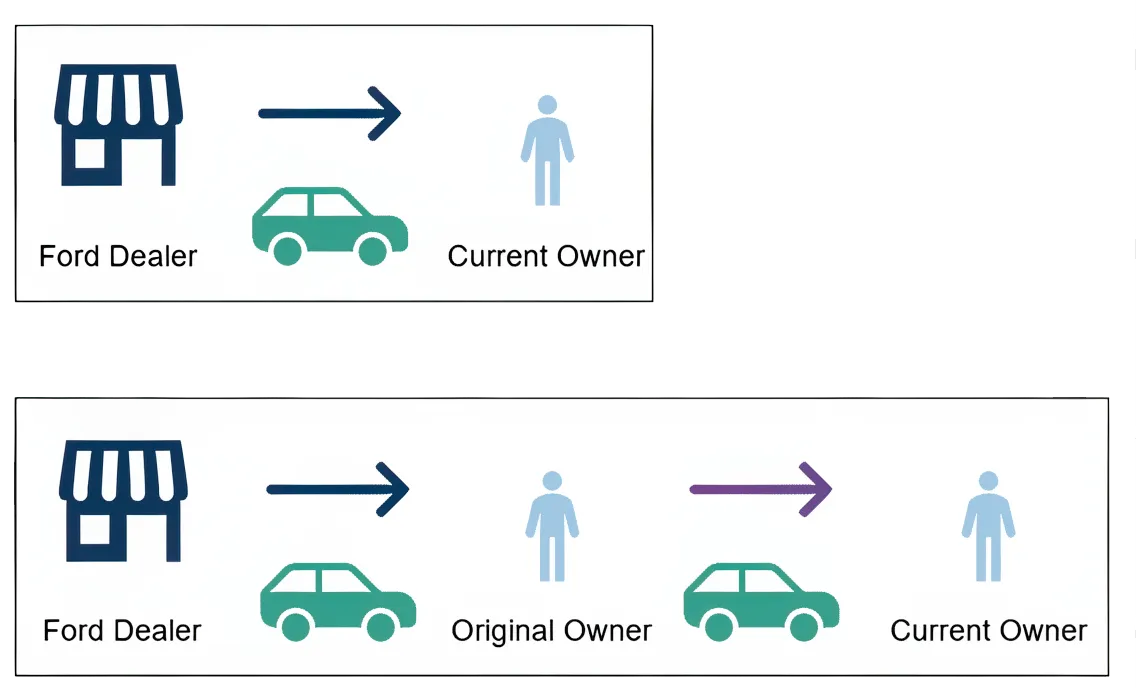
Who should wait until after the appeal is over to get rid of their vehicle? For all other current owners of an Affected Vehicle, your entitlement to claim reduction in value damages is subject to an appeal. We therefore recommend that you retain title to your vehicle until the appeal is complete.
If you are unsure at all about your chain of title, we recommend that you retain title to your vehicle until the appeal is complete.
Next steps
The proceeding is currently listed for a five-day hearing in September this year to determine the quantum of damages and interest for group members who purchased an affected vehicle new or second-hand in a private sale (in addition to a few other issues of entitlement).
For all other group members, the entitlement to claim reduction in value damages is subject to an appeal and we recommend that you retain title to your vehicle. We will provide further updates on the appeal in due course.
The lawyers are Corrs Chambers Westgarth, Australia’s leading independent law firm.
The case is funded by Martin Place Litigation Services Pty Limited.
Unfortunately, the wheels of justice turn slowly, and class actions of this scale and complexity take many years to work their way through the Court system. This case has now reached the stage of the proceedings where the Court is set to resolve the remaining issues regarding the entitlements of class members.
We are bringing a claim against Ford on behalf of people who bought or leased (or otherwise acquired an interest in) certain Ford vehicles (either new and used) fitted with a “PowerShift” transmission, at any time during the period 1 January 2011 to 20 December 2024. We estimate that there are approximately 73,000 affected vehicles. All owners, past and present, of these vehicles may be class members.
People who acquired a second-hand vehicle may be eligible for compensation too.
The Federal Court has recognised that “it is quite possible that once a group member ceases to own their vehicle, they will lose the entitlement to reduction in value damages”. Accordingly, class members who currently own their vehicle and wish to remain entitled to reduction in value damages should retain ownership of their vehicle. However, class members who no longer own their vehicle may still be entitled to consequential losses.
There are several reasons why a vehicle may be ineligible, including:
- It is not a model fitted with the “PowerShift” dry dual-clutch transmission system.
- It was not acquired within the relevant time period.
- You have already settled your claim with Ford.
- You have opted-out of the class action.
People who have sold their vehicle may still be eligible to receive compensation for consequential losses.
Our legal team are working hard behind the scenes to progress your claim and are making good progress. We will endeavour to provide you with regular updates, either through this website or via Court-approved notices.
In addition, you can always get in touch via email at fordclients@corrs.com.au.
Yes. We take your privacy and information security very seriously. We will not disclose your information to anyone else or use it for any purpose except for the claim against Ford.
Ready to Take the Next Step?
Join the Ford PowerShift class action and stay informed about your potential entitlements.